

History
Posted with permission by The History Guy (2020)
John Milton Hay
Born in 1838, son of a rural Illinois doctor, Hay graduated from Brown University and at age twenty-two was chosen as private secretary to Abraham Lincoln. He went on to serve as ambassador to Great Britain and served as Secretary of State under presidents William McKinley and Theodore Roosevelt.
The Fells
The Fells, named after Hay's ancestral Scotland, is situated on a hillside in Newbury, NH and overlooks scenic Lake Sunapee. It was on these shores that John and his wife, Clara Louise Stone, sought refuge from public life and in 1888 Hay quietly began acquiring abandoned farms that would eventually total nearly 1,000 acres.
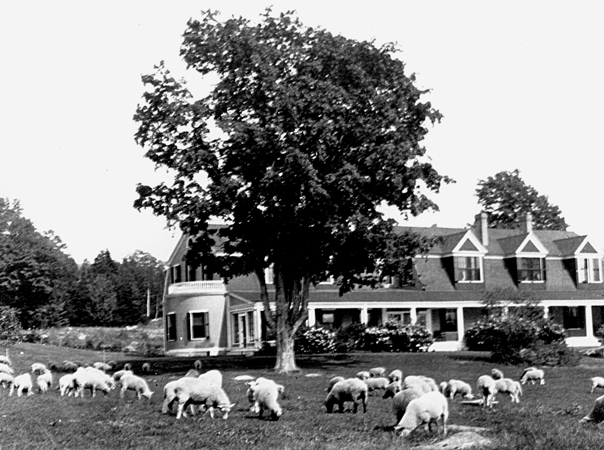
In 1889 John and Clara hired architect George F. Hammond to design the Colonial Revival, gambrel-roofed structure that reflected the prevailing summerhouse style of the time. Construction was completed in 1892, and was followed by expansion of a second cottage in 1897. Clara had a garden of roses and hydrangeas, but the lawn was still littered with boulders left from the ice-age, and sheep grazed nearby. When John Hay died at The Fells in 1905 the property passed to his son Clarence.

From 1906 through the 1930s, Clarence Hay and his wife, Alice Appleton Hay, transformed The Fells into an exceptional American estate and working farm. They remodeled the cottage into a stately country home and undeterred by the encroaching pines and boulder-strewn fields of Newbury, the Hays transformed sheep pasture into terraced lawns and formal gardens.
The Fells served as a summer retreat for three generations of the Hay family, each generation leaving behind its own special legacy in either history, horticulture or ecology. Experiencing the connections between this landscape’s diverse elements is often the visitor’s strongest memory.
Tours
Historic guided tours of the Main House are conducted once daily at 1:00pm, Wednesday through Sunday, mid-June through Labor Day weekend and Saturdays and Sundays through Columbus Day. House tours are included in the price of admission.
Understanding Hay History
Within his multiple roles of government, John Milton Hay had a hand in many different political decisions. These moments in history were essential during the time- but it can be hard to understand them all in the modern era.
The Big Picture
John Hay was instrumental in four major political decisions during his time as Secretary of State:
1898: Spanish-American War
Coming into office towards the end of the war, John Hay's legacy can be found in the final negotiations- especially in his push for the US to gain control of the Philippines.
1899-1900: The Open Door Policy
The late 1800s was a tumultuous time in China. John Hay's Open Door Policy would be monumental in securing China's sovereignty- but this policy went through many trials to reach its end point.
1901-1903: Panama Canal
Now under President Theodore Roosevelt, John Hay's foreign policy work would shift south towards Panama.
1903: Alaskan Border Disputes
While many of John Hay's policy agreements dealt with foreign lands, he also had a hand in ending a dispute between the US and Canada regarding land borders.